Almanity Hoi An
Resort & Spa.
1 critic review
filed.
Mostly, if you buy the premise. The included daily treatment turns spa from a splurge into a routine, and the design has real character. But it rewards guests who slow down and use the wellness side; treat it as a standard resort and the compact rooms will feel like thin value.
Fairly under-the-radar. Its social footprint is small and it does not chase the beachfront-resort spotlight, so it flies below the Instagram radar despite the striking spa complex. Wellness-minded travellers who find it tend to keep it to themselves, which is part of the appeal.
angles.
A treatment a day, included
The My Chi spa is not an add-on here, it is the concept. Your stay includes a treatment for each day, drawn from a menu that leans on local balms, oils and old Vietnamese fables rather than generic hotel-spa fare. Forty treatment rooms, a Himalayan salt sauna, herbal steam and a vitality pool mean you can actually use what you paid for instead of queuing for one masseuse.
Duplex Lofts echo old townhouses
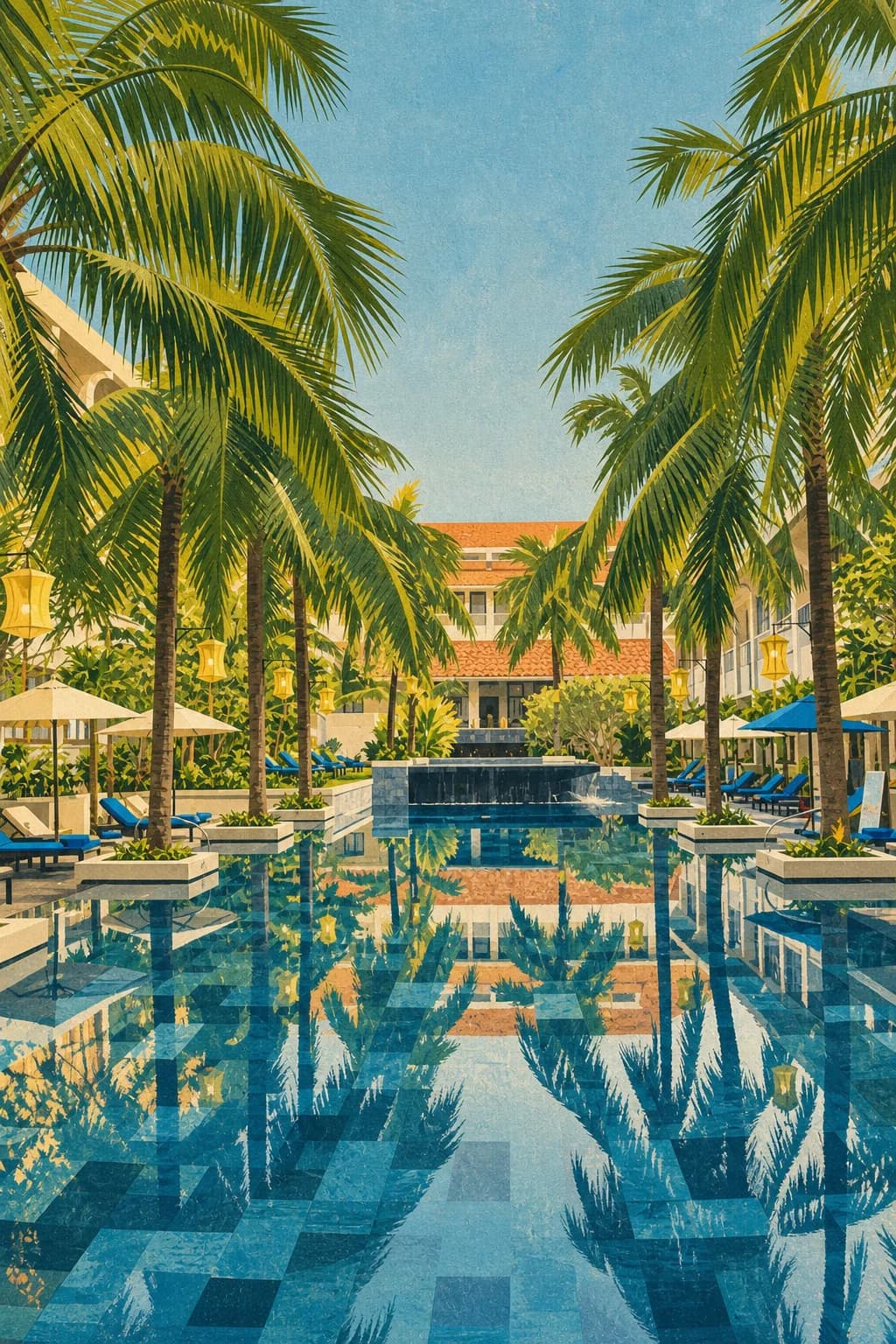
The building has no fence and the rooms skip the wardrobe, which sounds odd until you feel how open it makes everything. The Loft category is the signature: a duplex with a living area below and bedding up top, a deliberate nod to the 1980s Hoi An homes just streets away. The wider look mixes Japanese restraint, Indochina detailing and Portuguese colour without shouting about it.
Walk to the lanterns
Cam Pho puts you on the quiet edge of the Ancient Town, close enough to walk into the lantern-lit lanes and tailor shops but far enough that you sleep through the night market's noise. You can wander to the Japanese Bridge, eat cao lau at a street stall, and be back at the pool inside an hour. The beach at An Bang is a short cab ride when you want sand.
talk.
mapped.
record.
That one decision reorganises the whole place around slowing down. Almanity sits in Cam Pho, on the walkable edge of the Ancient Town, behind no fence and inside a design that borrows Japanese calm, Indochina lines, and a little Portuguese colour.
The 140 rooms lean minimalist, and the Loft category stacks a living area under an upstairs bed to echo the old 1980s townhouses a few streets over. The spa is the real centre of gravity: forty treatment rooms, a Himalayan salt sauna, herbal steam, a vitality pool. Fodor's has covered it. It stays bookable most of the year, but dry-season crowds and lantern-festival weeks claim the quietest rooms first, so plan around those.
changed.
Hoi An's demand curve has one sharp spike and a long, flat tail, and understanding why saves both money and disappointment. The February-to-April peak exists because it is the only stretch when central Vietnam reliably delivers dry, mild days. Everything else in the calendar trades certainty for value.
February through April is the only genuinely reliable weather window, and the entire market knows it. The winter rains have gone and the brutal summer heat has not yet arrived. That stretch also overlaps Tet, the lunar new year, which stacks a wall of domestic demand on top of the international crowd. If you want a specific room in a small Cam Thanh retreat or a heritage resort near the Covered Bridge during these months, plan on booking three to six months out. The top-tier addresses are few, and they sell their peak dates first.
May and September are the genuinely undervalued months. They sit in the shoulder band on price and availability but still deliver plenty of usable weather, and September in particular lands before the rains turn serious. The deep summer of June through August is hot and humid, which is exactly why it prices as shoulder. For beach-first travelers and families who will spend the afternoons in a pool or at An Bang, that heat is a feature, not a deterrent, and it is the easiest time to walk into a good room on short notice.
October and November are the honest gamble. This is central Vietnam's wet season, and the Thu Bon can rise enough to flood the Ancient Town's lower streets; locals paddle boats down them most years. Demand stays in the shoulder band, which means the rooms are there and the rates are soft.
You are trading certainty for value, but nothing closes, so the calculus is yours.
The lantern festival cuts across every month and ignores the seasons entirely. It falls on the fourteenth night of each lunar cycle, when the town douses its electric lights for candlelit lanterns. It is worth building a trip around, and it is not a summer-versus-winter decision. Check the lunar calendar, then pick your dates.
approach.
briefing.
stands.
demand's going.
The real Instagram following over time, plus where this hotel sits for demand in Hoi An. Pick a range, toggle the lines. Followers are reach and demand, not engagement.
assessment.
File closes at MODERATE. It books through the year with room to spare, so plan a few weeks out and longer for dry-season and festival peaks. Book it if a daily spa and a dawn walk into the old town is the point; skip it if you want beachfront or suite grandeur.
The numbers behind the tiers
Almanity Hoi An Resort & Spa · SOURCE READINGS · REDACTED- Availability density · sampled
- Monthly search volume · raw
- TikTok hashtag views · raw
- YouTube total views · raw
- TikTok following · latest sweep
- Pinterest saves · latest sweep
More from Hoi An.








Get the hotel's Unbookable Score.
Any post or reel with a hotel in it. Booking.com hotel pages work too. One free check, no account needed.