Royal Mansour
Marrakech.

8 critic reviews
filed.
Royal Mansour was built by royal commission and every detail was executed at a level you rarely see outside museum restorations. The 53 individual riads, the underground service tunnels, the silver cart at breakfast, all real. What the hype softens: you are paying for craftsmanship and discretion, not for the buzz of a trendy medina hotel, and the clientele skews accordingly formal.
The spa is open to non-guests for full-day access and includes the hammam, the pools, and the lounge areas. Book a weekday slot in shoulder season and you get the Mansour production values for under the cost of a suite night, with lunch in the garden included if you time it right.
angles.
53 Buildings, One Hotel
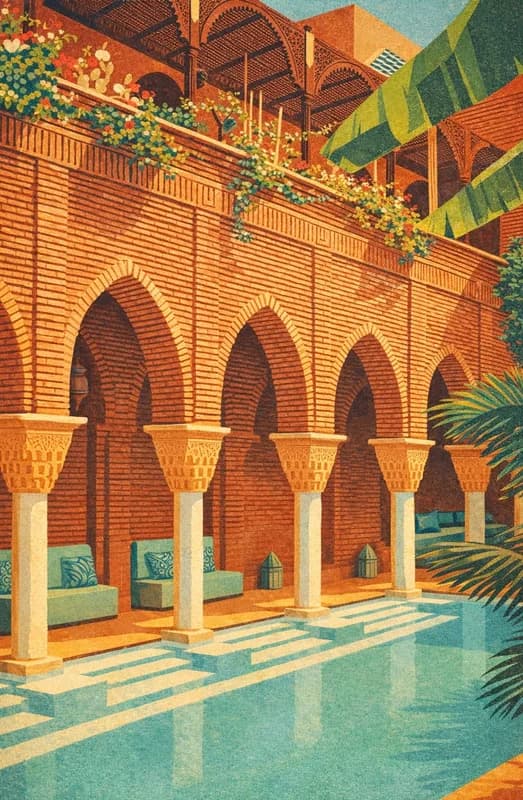
Every room is its own riad: a standalone building with a private entrance, internal courtyard, and rooftop terrace. Guests never share a corridor. The underground service tunnels mean staff appear and disappear without crossing guest space. The format is unique at this scale. Fifty-three individual buildings connected by lanes that replicate a traditional Moroccan medina in miniature.
Vallejo's Gardens
Luis Vallejo designed the landscape gardens in 2016, adding four hectares of botanical design to the compound. The gardens are structured around water channels, palm groves, and flowering beds that change with the season. The Vallejo landscape gives Royal Mansour an outdoor dimension that most medina properties, bound by walls and neighbours, cannot achieve.
Royal Commission
King Mohammed VI commissioned the hotel, which means the resources behind the construction were not constrained by commercial budgets. The craftsmanship throughout (zellige, carved plaster, painted cedarwood) was executed by Morocco's finest artisans working without deadline pressure. The royal provenance is visible in details that no investment fund would have approved on a spreadsheet.
talk.
mapped.
“Conceived as a city within a city — guests stay in one of 53 private riads.”
record.
OBMI designed the architecture. Luis Vallejo designed the landscape gardens in 2016. Fifty-three private riads, each a standalone building with its own entrance, courtyard, and rooftop terrace. The scale is extraordinary: an entire medina of individual riads within a walled compound. Green Key certified.
Biomass boiler, composting, LED throughout, staff transit subsidies. Exceptional breakfast included. Kids' club. Pet friendly. Thirty minutes from RAK airport. At the $$$$$ tier, Royal Mansour competes not with other Marrakech hotels but with the world's most exclusive properties. The royal provenance and the private-riad format put it in a category of its own.
changed.
Book December four to six months out. October–November is the value window. Skip summer unless heat-tolerant.
In Marrakech, demand runs inverse to the thermometer. When Europe wants winter sun and the heat breaks, the city's riads compress into windows that close months ahead — and that pattern is entirely predictable.
December is the single Peak month, and it behaves like nothing else on the calendar. New Year's Eve collides with European winter-sun demand to squeeze the top properties into a roughly two-week window that books out far in advance. Plan on four to six months of lead time for Ultra-tier riads; three months is often already too late for properties like Riad BE or Le Riad Yasmine.
October and November deliver the best value relative to experience quality. Demand indexes high — 80 in October, 85 in November — but autumn rates at many properties run 30 to 60 percent below spring equivalents because the season falls outside European school holidays. October brings the 1-54 Festival, Marrakech's contemporary art biennale, adding a cultural layer spring lacks. November is the month our data flags as flat-out underpriced: it indexes at 85 without December's premium or the school-holiday crush.
March and April are the traditional high season, driven by Easter breaks and the spring weather window. Easter week is the tightest booking window outside December, and Jardin Majorelle requires timed-ticket advance purchase throughout this period. Ramadan shifts annually across the calendar; when it overlaps with March or April, restaurants and some services run reduced hours while hotels stay fully open.
Check the Ramadan dates before you book — they reshape the dining and nightlife experience far more than the hotel experience.
Summer is the strategic play for price-sensitive travelers who can handle heat. Demand drops below 30 from June through August, and properties that validate as sold out in October often show wide-open availability through July. The medina's thick walls and internal courtyards were built for this climate, so morning and evening exploration stay comfortable — the tradeoff is that midday outdoor sightseeing is impractical. What disappears entirely is the sold-out pressure that defines the rest of the year.
September is the transition window, and it favors the early mover. Temperatures moderate and demand begins to climb, but rates have not yet caught up to autumn levels.
approach.
briefing.
“#13 in 2025 — hidden tunnels for invisible service.”
stands.
demand's going.
The real Instagram following over time, plus where this hotel sits for demand in Marrakech. Pick a range, toggle the lines. Followers are reach and demand, not engagement.
assessment.
File closes at VERY HIGH. Book direct three months out, or aim for Ramadan or August for a quieter compound. Skip if anonymous luxury matters; the royal brand draws a high-recognition crowd.
The numbers behind the tiers
Royal Mansour Marrakech · SOURCE READINGS · REDACTED- Availability density · sampled
- Monthly search volume · raw
- TikTok hashtag views · raw
- YouTube total views · raw
- TikTok following · latest sweep
- Pinterest saves · latest sweep
More from Marrakech.
Get the hotel's Unbookable Score.
Any post or reel with a hotel in it. Booking.com hotel pages work too. One free check, no account needed.